Elementary number theory
Elementary number theory[edit]
The term elementary generally denotes a method that does not use complex analysis. For example, the prime number theorem was first proven using complex analysis in 1896, but an elementary proof was found only in 1949 by Erdős and Selberg.[77] The term is somewhat ambiguous: for example, proofs based on complex Tauberian theorems (for example, Wiener–Ikehara) are often seen as quite enlightening but not elementary, in spite of using Fourier analysis, rather than complex analysis as such. Here as elsewhere, an elementary proof may be longer and more difficult for most readers than a non-elementary one.

Number theory has the reputation of being a field many of whose results can be stated to the layperson. At the same time, the proofs of these results are not particularly accessible, in part because the range of tools they use is, if anything, unusually broad within mathematics.[78]
Analytic number theory[edit]


Analytic number theory may be defined
- in terms of its tools, as the study of the integers by means of tools from real and complex analysis;[70] or
- in terms of its concerns, as the study within number theory of estimates on size and density, as opposed to identities.[79]
Some subjects generally considered to be part of analytic number theory, for example, sieve theory,[note 10] are better covered by the second rather than the first definition: some of sieve theory, for instance, uses little analysis,[note 11] yet it does belong to analytic number theory.
The following are examples of problems in analytic number theory: the prime number theorem, the Goldbach conjecture (or the twin prime conjecture, or the Hardy–Littlewood conjectures), the Waring problem and the Riemann hypothesis. Some of the most important tools of analytic number theory are the circle method, sieve methods and L-functions (or, rather, the study of their properties). The theory of modular forms (and, more generally, automorphic forms) also occupies an increasingly central place in the toolbox of analytic number theory.[80]
One may ask analytic questions about algebraic numbers, and use analytic means to answer such questions; it is thus that algebraic and analytic number theory intersect. For example, one may define prime ideals (generalizations of prime numbers in the field of algebraic numbers) and ask how many prime ideals there are up to a certain size. This question can be answered by means of an examination of Dedekind zeta functions, which are generalizations of the Riemann zeta function, a key analytic object at the roots of the subject.[81] This is an example of a general procedure in analytic number theory: deriving information about the distribution of a sequence (here, prime ideals or prime numbers) from the analytic behavior of an appropriately constructed complex-valued function.[82]
Algebraic number theory[edit]
An algebraic number is any complex number that is a solution to some polynomial equation with rational coefficients; for example, every solution of (say) is an algebraic number. Fields of algebraic numbers are also called algebraic number fields, or shortly number fields. Algebraic number theory studies algebraic number fields.[83] Thus, analytic and algebraic number theory can and do overlap: the former is defined by its methods, the latter by its objects of study.



It could be argued that the simplest kind of number fields (viz., quadratic fields) were already studied by Gauss, as the discussion of quadratic forms in Disquisitiones arithmeticae can be restated in terms of ideals and norms in quadratic fields. (A quadratic field consists of all numbers of the form , where and are rational numbers and is a fixed rational number whose square root is not rational.) For that matter, the 11th-century chakravala method amounts—in modern terms—to an algorithm for finding the units of a real quadratic number field. However, neither Bhāskara nor Gauss knew of number fields as such.


The grounds of the subject as we know it were set in the late nineteenth century, when ideal numbers, the theory of ideals and valuation theory were developed; these are three complementary ways of dealing with the lack of unique factorisation in algebraic number fields. (For example, in the field generated by the rationals and , the number can be factorised both as and ; all of , , and are irreducible, and thus, in a naïve sense, analogous to primes among the integers.) The initial impetus for the development of ideal numbers (by Kummer) seems to have come from the study of higher reciprocity laws,[84] that is, generalisations of quadratic reciprocity.





Number fields are often studied as extensions of smaller number fields: a field L is said to be an extension of a field K if L contains K. (For example, the complex numbers C are an extension of the reals R, and the reals R are an extension of the rationals Q.) Classifying the possible extensions of a given number field is a difficult and partially open problem. Abelian extensions—that is, extensions L of K such that the Galois group[note 12] Gal(L/K) of L over K is an abelian group—are relatively well understood. Their classification was the object of the programme of class field theory, which was initiated in the late 19th century (partly by Kronecker and Eisenstein) and carried out largely in 1900–1950.
An example of an active area of research in algebraic number theory is Iwasawa theory. The Langlands program, one of the main current large-scale research plans in mathematics, is sometimes described as an attempt to generalise class field theory to non-abelian extensions of number fields.
Diophantine geometry[edit]
The central problem of Diophantine geometry is to determine when a Diophantine equation has solutions, and if it does, how many. The approach taken is to think of the solutions of an equation as a geometric object.
For example, an equation in two variables defines a curve in the plane. More generally, an equation, or system of equations, in two or more variables defines a curve, a surface or some other such object in n-dimensional space. In Diophantine geometry, one asks whether there are any rational points (points all of whose coordinates are rationals) or integral points (points all of whose coordinates are integers) on the curve or surface. If there are any such points, the next step is to ask how many there are and how they are distributed. A basic question in this direction is if there are finitely or infinitely many rational points on a given curve (or surface).
In the Pythagorean equation we would like to study its rational solutions, that is, its solutions such that x and y are both rational. This is the same as asking for all integer solutions to ; any solution to the latter equation gives us a solution , to the former. It is also the same as asking for all points with rational coordinates on the curve described by . (This curve happens to be a circle of radius 1 around the origin.)


The rephrasing of questions on equations in terms of points on curves turns out to be felicitous. The finiteness or not of the number of rational or integer points on an algebraic curve—that is, rational or integer solutions to an equation , where is a polynomial in two variables—turns out to depend crucially on the genus of the curve. The genus can be defined as follows:[note 13] allow the variables in to be complex numbers; then defines a 2-dimensional surface in (projective) 4-dimensional space (since two complex variables can be decomposed into four real variables, that is, four dimensions). If we count the number of (doughnut) holes in the surface; we call this number the genus of . Other geometrical notions turn out to be just as crucial.


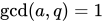
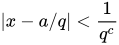
There is also the closely linked area of Diophantine approximations: given a number , then finding how well can it be approximated by rationals. (We are looking for approximations that are good relative to the amount of space that it takes to write the rational: call (with ) a good approximation to if , where is large.) This question is of special interest if is an algebraic number. If cannot be well approximated, then some equations do not have integer or rational solutions. Moreover, several concepts (especially that of height) turn out to be critical both in Diophantine geometry and in the study of Diophantine approximations. This question is also of special interest in transcendental number theory: if a number can be better approximated than any algebraic number, then it is a transcendental number. It is by this argument that π and e have been shown to be transcendental.


Diophantine geometry should not be confused with the geometry of numbers, which is a collection of graphical methods for answering certain questions in algebraic number theory. Arithmetic geometry, however, is a contemporary term for much the same domain as that covered by the term Diophantine geometry. The term arithmetic geometry is arguably used most often when one wishes to emphasise the connections to modern algebraic geometry (as in, for instance, Faltings's theorem) rather than to techniques in Diophantine approximations.


Comments
Post a Comment